Tel/Fax: +39 055.828315 [email protected] / Facebook


The latest news from the Joomla! Team


MVC Group , specialized in outdoor and cycling clothing with the Castelli, Karpos and Sportful brands , has announced the acquisition of 70% of Zoot , a leading American company in the production and marketing of triathlon clothing and accessories. Founded in 1946 by the Cremonese family, now in its third generation, MVC Group is 40% owned by the Equinox fund and in 2022 achieved a consolidated turnover of 132.4 million euros.
“The acquisition of Zoot is part of our growth and expansion strategy and is very important for the consolidation of MVC in the American market, where we have already operated with a subsidiary for more than 20 years, as well as allowing us to enter the triathlon segment, a sport that is experiencing significant growth rates with an attractive high-spending consumer base. Zoot's direct presence in the Philippines will also allow us to benefit from vertical production integration with a further strengthening of our platform which, to date, manages the Castelli, Sportful and Karpos brands", commented Alessio Cremonese, CEO of MVC Group .

Born in 1983 in Kona, Hawaii, with headquarters since 2003 in San Diego, California, a factory owned in the Philippines, Zoot is today one of the most important and recognized companies for triathlon . The company expects to close 2023 with revenues of approximately $10 million and EBITDA of $3 million.
“Thanks to the acquisition of Zoot, in addition to strengthening ourselves in triathlon, we have the opportunity to consolidate the Group's positioning in a strategic segment such as the Direct To Consumer channel, where Zoot generates approximately 70% of its turnover, with an operating margin above 30%”, underlined Alberto Cremonese, president of MVC and head of the IT division.

The Direct to Consumer channel represents an important development driver for MVC Group, and is an integral part of the growth project carried out after Equinox's entry into the shareholding structure. The goal is to bring the channel, which currently generates approximately 14% of turnover, to 20% of the total by 2025.
“We are proud to be alongside MVC in this acquisition which will allow the Group to pursue its growth and development path, with the addition of a new important brand of a sport that is increasingly conquering new consumers, the implementation of the DTC and the strengthening of the subsidiary in the USA, which will draw on the skills of Zoot's management team to manage MVC's entire American business. With this operation, MVC Group also confirms its ability to grasp the challenges and trends of the market and to be an active part as an industrial unifying reality in the sector", added Massimiliano Monti, partner of Equinox.
Following the acquisition, Doug Vargo, current CFO of Zoot, will be named CEO of Zoot and MVC US ; Shawn O'Shea takes over as global head of the triathlon division and will manage both the Zoot and Castelli brands for the triathlon.
“We are thrilled to be able to become part of a Group like MVC and we are convinced that the great expertise of its management and the synergies that can be developed will offer new development opportunities for Zoot. Thanks to MVC's e-commerce platform we will also be able to expand our borders and reach new and interesting markets such as Europe, Japan and China", concluded Shawn O'Shea, current president of Zoot.

Switching to middle distance triathlon and want help with your training? Here's all the advice you need plus two free training plans
A 70.3 distance triathlon consists of 1.9 km of swimming, 90 km of cycling and 21.1 km of running . It is also known as a half Ironman or middle distance triathlon .
This race distance can take the fastest athletes in under 4 hours and has an upper limit of 8.5 hours. This makes it a distance that represents a big step up for most athletes.
You will need : a wetsuit that will support you during a longer swim, protective glasses, road bike, helmet and trainers .
You can usually change between disciplines, but a good triathlon suit is ideal for medium distance racing.
You will also need : a nutrition plan that includes salts, hydration and fuel for cycling and running . Often training will be completed twice a day during the week, so your lifestyle needs to support this - make sure you're sleeping and fueling well.
Middle distance races are often said to be the “perfect distance” because they combine the endurance of long distances and, more importantly, the speed of short course racing.
For many triathletes, tackling a 70.3 race is the furthest they will ever go, for others it is a stepping stone to full-distance IRONMAN racing. Whatever it is for you, it should not be taken lightly and requires a commitment to training for race day to be successful.
To complete a 70.3 it's best to have some experience racing triathlons and, ideally, know how your body reacts to exercise stress after 2-3 hours.
Before starting this training program, we expect that you will have already done some basic training during the off-season so that you can complete the sessions described from the first week.
This training plan consists of three different phases: BASE PHASE (8 weeks) + BUILDING PHASE (8 weeks) + PEAK PHASE (8 weeks)

This half Ironman training plan is designed for those who are able to commit to six days a week training for eight weeks
You will need a decent base level of fitness and the ability to work at different levels of intensity.
A key element in this half Ironman training plan is that some weeks have a number of "double days" where there are two training sessions: it is not necessary to do them in succession and, in fact, it is better to recover between training sessions. 'other and be ready to execute each session as strongly as possible.
Consider the best way to refuel between sessions on double days, with the right hydration and nutrition.
Each week includes a swim, possibly in open water. It is absolutely crucial that you spend enough time preparing for the swim; if you can feel as comfortable as possible in the open water environment and start the race well, then you have a great chance of overall success in the race.
Practice spotting, group swimming and getting used to physical contact, as well as building your swimming stamina.
If, as an athlete, you're used to running shorter distances at higher intensities, part of the transition to middle-distance races is to reduce your speed slightly but improve your endurance to tolerate stress for longer periods.
Longer bike and rides, as well as combined sessions, are your ideal opportunity to adjust your middle distance race pace.
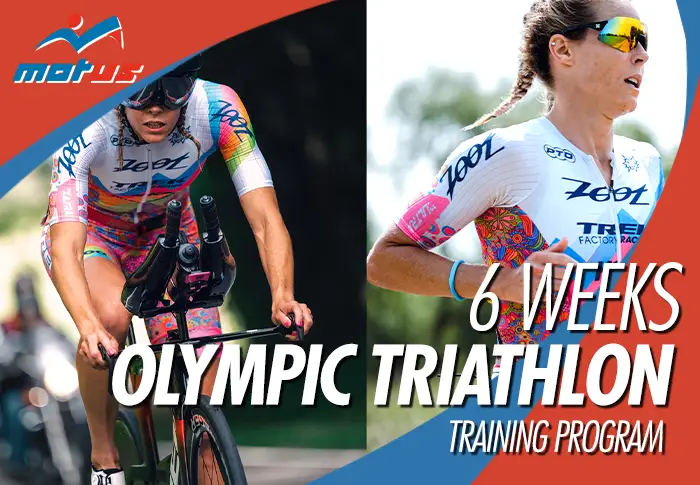
Many of us would like to live the life of a professional athlete. Every aspect is programmed according to sporting performance: training, nutrition, sleep and rest.
But not being professionals, we have to adapt our training to busy modern lives, which usually include a home life, a work life, and a social life, and so on.
When you realize that you don't get paid to train and that your life includes many extra-sports commitments, you often have to sacrifice the amount of training you do.
This doesn't mean giving up and not challenging yourself, but you need to be well organized and rigorous in managing the time you dedicate to training
This six-week plan is suitable for those who only have 1 hour to train each day of the week and have a little more time available on the weekend.
You must be very good at time management, know how to divide the day and treat training sessions as appointments not to be missed.
Since training cannot last too long during the week, it is essential to focus more on the intensity of the sessions, making them more vigorous and challenging.
Competing in the Olympic triathlon requires absorbing fairly high levels of effort. Interval and pace sessions during the week help you get used to that uncomfortable feeling, while dedicating the weekend to that longer endurance session helps maintain the right balance between covering the distance and doing it to the best of your ability.
This training plan is varied but well balanced between the amount of swimming, cycling and running needed. If there was one key session not to be missed during the week, it would be the multi-brick (combined workouts), which prepares you for the race, simulates that feeling of being at the maximum limit and running away from the bike to evaluate your best pace.
Always include a warm-up and cool-down in each session. Warm-up = 5-8 minutes of gradual intensity from easy to vigorous. Cool down = 3-5 minutes of easy cardio followed by stretches
Before reading the training table, here are 4 general tips for the Olympic distance
1. Structure is key
Time is precious, so make sure you structure the sessions into your day like an appointment. If possible, get up early and get them done before life gets in the way.
2. Fuel
Practice drinking and taking energy products on the go. You don't want to waste time stopping to refuel. Experiment to find the best form of nutrition.
3. Swim with others
Prepare for the physical nature of open water swimming by practicing with others. Get used to swimming very close to people. Try not to let it upset you. Be strong!
4. Don't forget the combined workouts (brick)
Focus on improving the way you transition from cycling to running. Determine your best running speed for the first mile to stay consistent. Multi-bricks are really useful for this.
 CALL US
